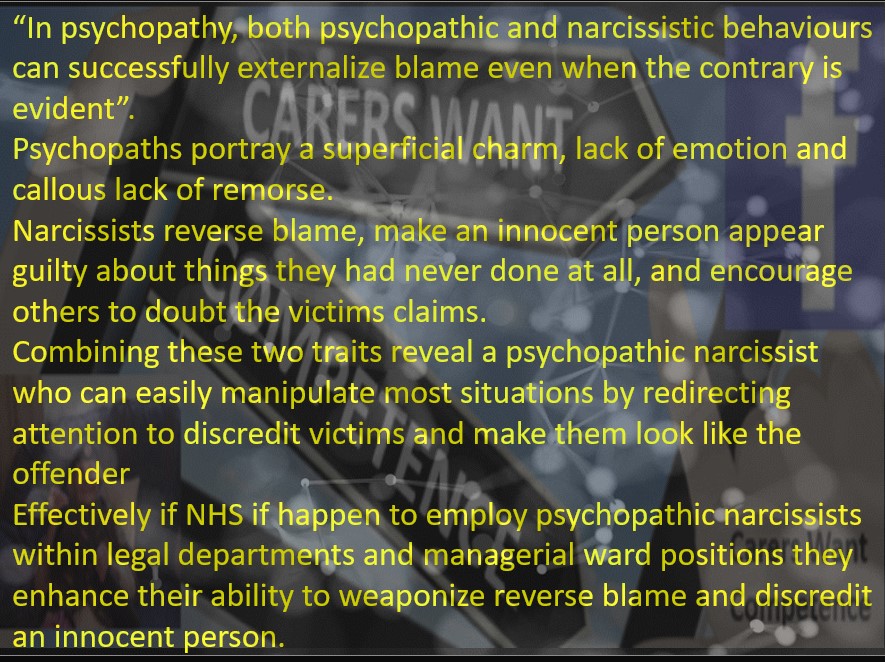
Psychopaths portray a superficial charm, lack of emotion and callous lack of remorse.
Narcissists reverse blame, make an innocent person appear guilty about things they had never done at all, and encourage others to doubt the victims claims.
Combining these two traits reveal a psychopathic narcissist who can easily manipulate most situations by redirecting attention to discredit victims and make them look like the offender
Effectively, if NHS if happen to employ psychopathic narcissists within legal departments and managerial ward positions they enhance their ability to weaponize reverse blame and discredit an innocent person.
“Only the person who believes he has been defamed may bring libel proceedings.”
So why would Gloucestershire Constabulary acting as ‘Claimant’ for individual NHS staff, an owner of a ‘care’ company and withhold evidence of neglect and covert behaviour?
My opinion is that police are not acting impartially, and that senior officers are collaborating by portraying complicity in concealing NHS gross negligence manslaughter. (This is a criminal offence that they refuse to investigate).
If you are in a situation that you have to defend yourself against NHS psychopathic narcissists of legal department and ward staff, recorded evidence is the way to beat them. But be sure to store copies of your evidence away from your home.
“Courts tend to give more weight to contemporaneous notes especially so where there may be corroborating recordings, which can be critical evidence”.
Having written, audio and visual recordings as a timeline of events is helpful because it serves as an anchor of what actually occurred, countering the psychological toll of gaslighting, and empowerment of maintaining clarity amidst NHS manipulation.
Truth (Defamation Act 2013, s.2)
A claim in defamation will fail where the defendant can demonstrate that the imputation conveyed by the statement is substantially true.
Honest opinion (Defamation Act 2013, s.3)
Where the defendant publish statements of opinion and statements of fact, a defamation claim will fail if the defendant can show
(1) that the statement indicated, in general or specific terms, the basis of the opinion
and
(2) that the opinion could have been held by an honest person on the basis of facts which existed at the time the statement was published or on the basis of anything asserted to be a fact in a privileged statement published before the statement complained of.
Carers Want Competence: Your Public Watchdog for Accountability in Care
As a GNS Press Accredited Citizen/Public Interest Journalist (engaging in journalist activities) and independent public watchdog, Carers Want Competence is dedicated to rigorously scrutinising, investigating, and exposing extreme and systemic institutional failures, poor practice, and serious misconduct within all areas requiring duty of care and accountability, including health, social care, mental health, domiciliary, residential, and nursing care across the UK and internationally.
My activities involve comprehensive research, including investigating publicly available information on the conduct of individuals and institutions involved, to inform these exposures. I also engage in investigative work and am sometimes contacted by mainstream media investigative journalists.
We believe heightened public awareness and engagement are crucial to fighting these abuses, restoring dignity, and ensuring an acceptable standard and quality of care for vulnerable individuals, service users, residents, and their families. Our work directly parallels efforts like the recent success of Rashid Abbasi case, underscoring the vital public interest in naming individuals complicit in serious failings to achieve accountability.
Our mission is to foster transparency and secure accountability where it's desperately needed. We highlight:
Corporate abuses of power and organizational toxic cultures that disregard individual rights and duty of care.
The widespread problem of neglect and abuse often disregarded or concealed, denying individuals and families justice.
Fabricated allegations and reverse-blame tactics used by professionals and management to silence whistleblowers and advocates who seek to expose wrongdoing.
Protecting Future Lives: We cannot stress enough the importance of advocating for the rights, safety, and protection of future patients and their families. Our efforts aim to deter poor provision of care and lead to more impactful results for the entire community.
Support Services:
Beyond raising awareness and exposure of poor practises, we offer a completely free service of advice, referrals, emotional and practical support (including face-to-face assistance), mediation, and representation.
With over twenty years of experience as a complex needs family carer and a background as a Support Coordinator in the care sector, I provide informed advocacy and support. We also collaborate with whistleblowing organizations to ensure anonymity for care professionals who wish to report concerns in confidence.
Member of: National Association of Care and Support Workers, Care Home Professional, and GNS Press.
Contact us: carerswantcompetence@gmail.com or 07548075602.
Content Disclaimer: Please note that content shared on this page may contain graphic and disturbing details due to the nature of the issues we report on
View all posts by Carers Want Competence

 Carers Want Competence